Teleporio™ — Greek Island Travel Intelligence
Why is Mikis Theodorakis so important to Greece?
He composed Zorba the Greek and the Cavafy songs. He was imprisoned during the junta. He is the composer whose music became the sound of Greece's conscience.
Teleporio™ travel intelligence — Updated 2026-07-24
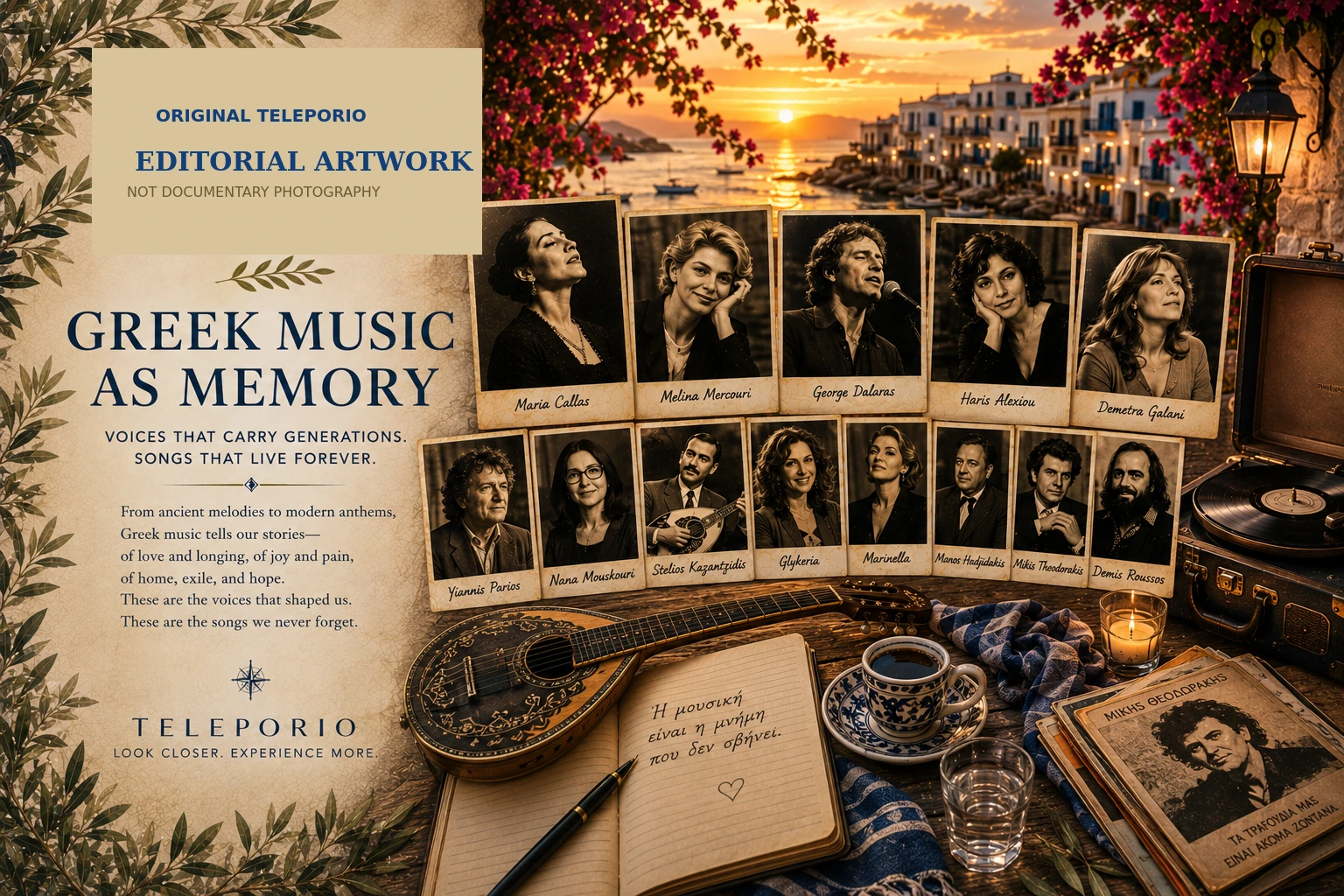
Zorba the Greek is the piece the world knows. But the music that matters most to Greeks is the political song cycles — the settings of poetry by Seferis, Ritsos and Elytis — that Theodorakis made during the years when such music was dangerous.
Who he was
Mikis Theodorakis (1925–2021) was the most internationally known Greek composer of the twentieth century and one of the most politically consequential musicians in modern Greek history. He was born on the island of Chios and spent his life moving between music, politics and the intersection of the two — a Greek life in full, with all the political turbulence that implies. He composed symphonic works, film scores, songs and cantatas, and he was among the first composers anywhere to bring classical compositional methods to the setting of major modern Greek poetry.
The music the world knows
Theodorakis composed the music for the 1964 film Zorba the Greek, directed by Michael Cacoyannis and starring Anthony Quinn. The score — including the famous sirtaki dance sequence — became one of the most recognisable pieces of music associated with Greece anywhere in the world. But sirtaki itself deserves a note of honesty: it was a dance invented specifically for the film, drawing on traditional Greek dances but not itself a traditional form. Theodorakis composed it; Anthony Quinn and Cacoyannis developed the choreography. It is perhaps the most successful piece of invented tradition in modern film history.
The song cycles and the poets
For Greeks, Theodorakis's deepest legacy is not Zorba but the settings he made of major modern Greek poetry — cycles of songs that brought the work of poets such as Giorgos Seferis, Yannis Ritsos, Odysseas Elytis and Nikos Gatsos to mass audiences in accessible musical forms. The Axion Esti cycle, setting the text of Elytis's great poem of the same name, remains one of the landmarks of modern Greek cultural life. These works created a public for serious Greek poetry in a way that publication alone never had, and they gave ordinary people a way to carry major literature in their bodies — through melody, through dancing, through singing.
The junta years
When the military dictatorship seized power in Greece in 1967, Theodorakis was among the first to be arrested. His music was banned by the regime — a ban that was, in the history of censorship, one of the most eloquent tributes to a composer's political power. He was imprisoned and held under conditions that damaged his health. International pressure, led by figures including Dmitri Shostakovich and others, contributed to his eventual release. During the years of exile and imprisonment, his music was sung covertly in Greece and openly by Greeks abroad. A melody becomes an act of resistance when the authorities who rule you forbid it.
Why a traveller should care
When you hear Greek music in Athens — in a concert hall, in a taverna, at a festival — and you recognise a melody that feels more weighty than entertainment, there is a real possibility you are hearing Theodorakis. His music is embedded in the Greek emotional vocabulary in a way that goes beyond popularity. It carries memory: of resistance, of suffering, of the particular kind of cultural courage that keeps singing when singing is forbidden. To know his story is to hear his music differently — and to understand something true about Greece that no monument quite conveys.
What is certain — and what is interpretation
Mikis Theodorakis (1925–2021) is a documented historical figure. Biographical details draw from widely published and cross-checked sources including the composer's own published memoirs and interviews, news archives, and institutional records. No quotes are attributed to him in this article.
Go See It
Athens Concert Hall (Megaron Mousikis) and the Municipal Theatre of Piraeus
Theodorakis's works are regularly performed in Athens, at the Megaron Mousikis and at the Odeon of Herodes Atticus during summer. The Municipal Theatre of Piraeus, near the port, has a strong connection to the laïko and entechno tradition in which his work sits. Summer festivals across Greece frequently include performances of his major works.