Teleporio™ — Greek Island Travel Intelligence
Why are Greek churches named after particular saints?
Before it was a building, it was a person. Understanding why a church carries a particular name turns every chapel in Greece into a story you can read.
Teleporio™ travel intelligence — Updated 2026-07-24
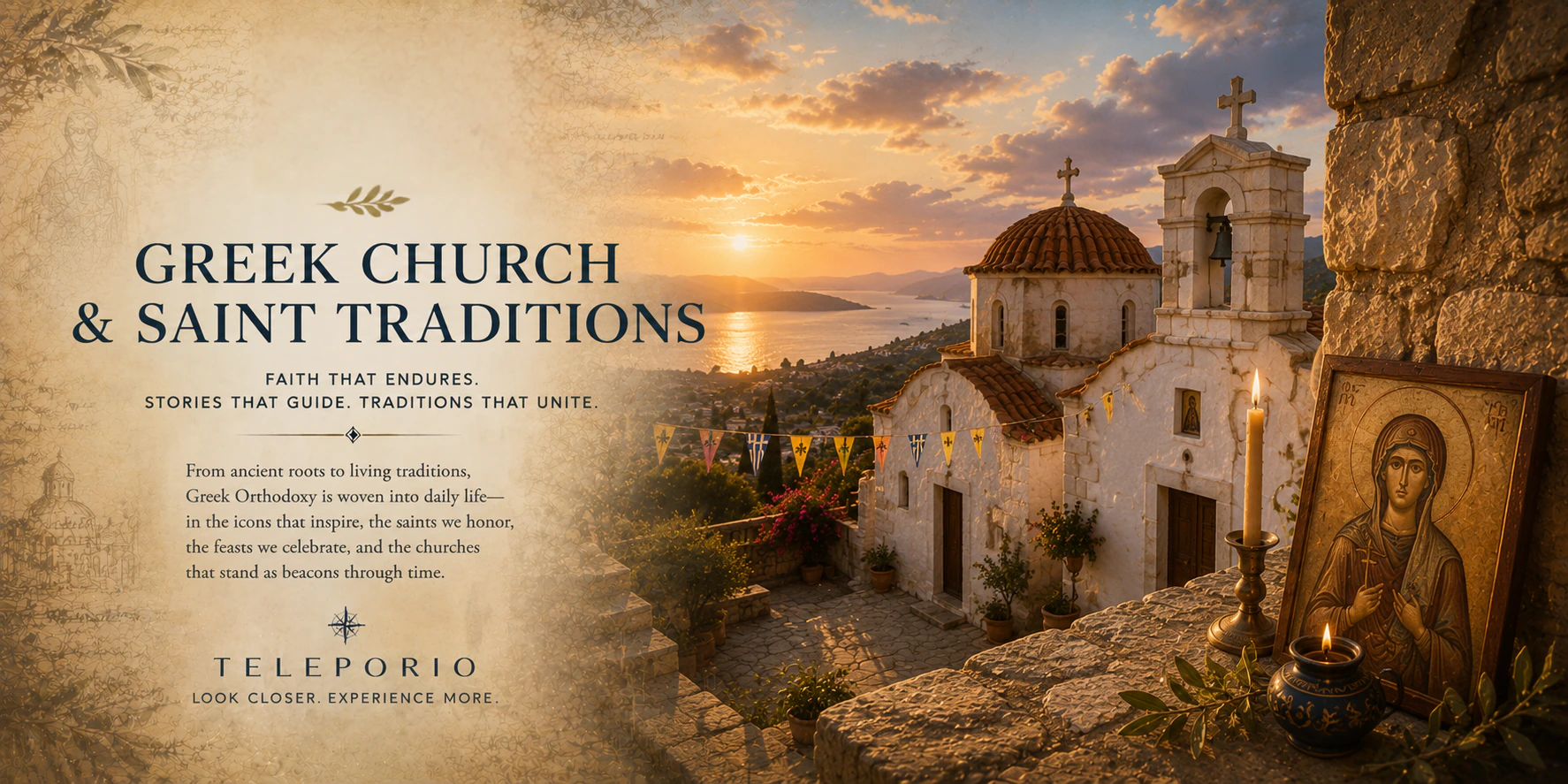
Every Greek Orthodox church is dedicated to someone. That someone has a story — and a feast day. When you know that, you stop passing churches without thinking about them.
The dedication: what it means
In the Greek Orthodox tradition, every church is dedicated to a particular saint, to the Virgin Mary (the Panagia), or to a major feast of the church calendar. The name the church bears is not merely an administrative label; it identifies the saint or holy figure to whose memory and intercession the community has entrusted the church. The building is, in the deepest sense, a house built in honour of that person. The local congregation that worships there is, in a traditional Orthodox understanding, under the protection and care of that saint.
Who the saints are
Saints in the Orthodox tradition are men and women whom the Church has recognised as living embodiments of Christian faith — people whose lives exemplified courage, compassion, faith, service or witness to the point where their memory became a source of inspiration and intercession for others. Their histories are varied: some were early Christian martyrs who died rather than renounce their faith under Roman persecution. Others were monks or hermits whose ascetic lives of prayer attracted reverence. Others were bishops, teachers, charitable figures or missionaries. Some were healers, associated by tradition with miraculous recoveries. The Church does not require a saint to have suffered violently; the life of faith and service is itself the ground of recognition.
Why people ask saints for help
A question that visitors often have — and that deserves a careful, respectful answer — is why Orthodox Christians ask saints for help, when the Christian God is believed to be directly accessible in prayer. In Orthodox understanding, asking a saint for help is not asking the saint instead of God; it is asking the saint to pray to God on the believer's behalf. This is called intercession. The saints, in Orthodox belief, are not separate from God but close to Him — their prayers, in this understanding, carry particular weight. When a Greek person lights a candle and asks Saint Nicholas to protect a sailor in the family, they are asking him to intercede — to pray for that person — not to act independently. This distinction is important for a traveller to understand, because it is the actual theological meaning of the practice, and it is different from how it might be imagined from the outside.
Feast days and the living calendar
Every saint has a feast day — a day in the Orthodox calendar commemorating their life and death. On a church's name-day (the feast day of the saint to whom it is dedicated), a special liturgy is held and often a panigyri — a community festival involving music, food and celebration — takes place. This is one of the ways in which the Greek Orthodox calendar structures community life: the year moves not simply through seasons but through the feast days of the saints, and different saints belong to different places, islands and communities as their particular patrons. In a Greek village, knowing the patron saint's feast day is knowing when the community celebrates itself.
What this means for a traveller
When you enter a Greek church and read the saint's name above the door, you are looking at the beginning of a story. Every Agios Nikolaos (Saint Nicholas) church marks the patron of sailors — a saint whose wide veneration in coastal and island Greece reflects the dominance of the sea in Greek life. Every church of Agios Georgios (Saint George) points to the dragon-slayer of legend, patron of warriors and of many Greek communities. Every Panagia church is a declaration that the Virgin Mary is the most beloved figure in the Orthodox pantheon, the 'Theotokos' (Mother of God), whose intercession is sought by many more people than any individual saint. Learning to read these names is learning a language the entire landscape of Greece speaks.
What is certain — and what is interpretation
The practice of dedicating Christian churches to saints, the theological basis of saint veneration in Greek Orthodoxy, and the tradition of feast days are described here as Orthodox Christian belief and practice, clearly identified as such. The brief biographical notes on individual saints draw from sources within the Orthodox tradition and from widely cross-checked historical scholarship.
Go See It
Any village or island church, particularly those with active feast-day traditions — Hydra, Tinos, Paros, Patmos
If you happen to be in a Greek village or island on the feast day of the local patron saint, stay for the evening liturgy and the panigyri that follows. These are not tourist events; they are genuine community celebrations, and visitors who approach with respect and curiosity are typically welcomed warmly.