Teleporio™ — Greek Island Travel Intelligence
Why did the Olympics begin in Greece?
They began in Olympia around 776 BC as a religious festival in honour of Zeus, and they ran for over a thousand years. The modern Games inherited their name,…
Teleporio™ travel intelligence — Updated 2026-07-24
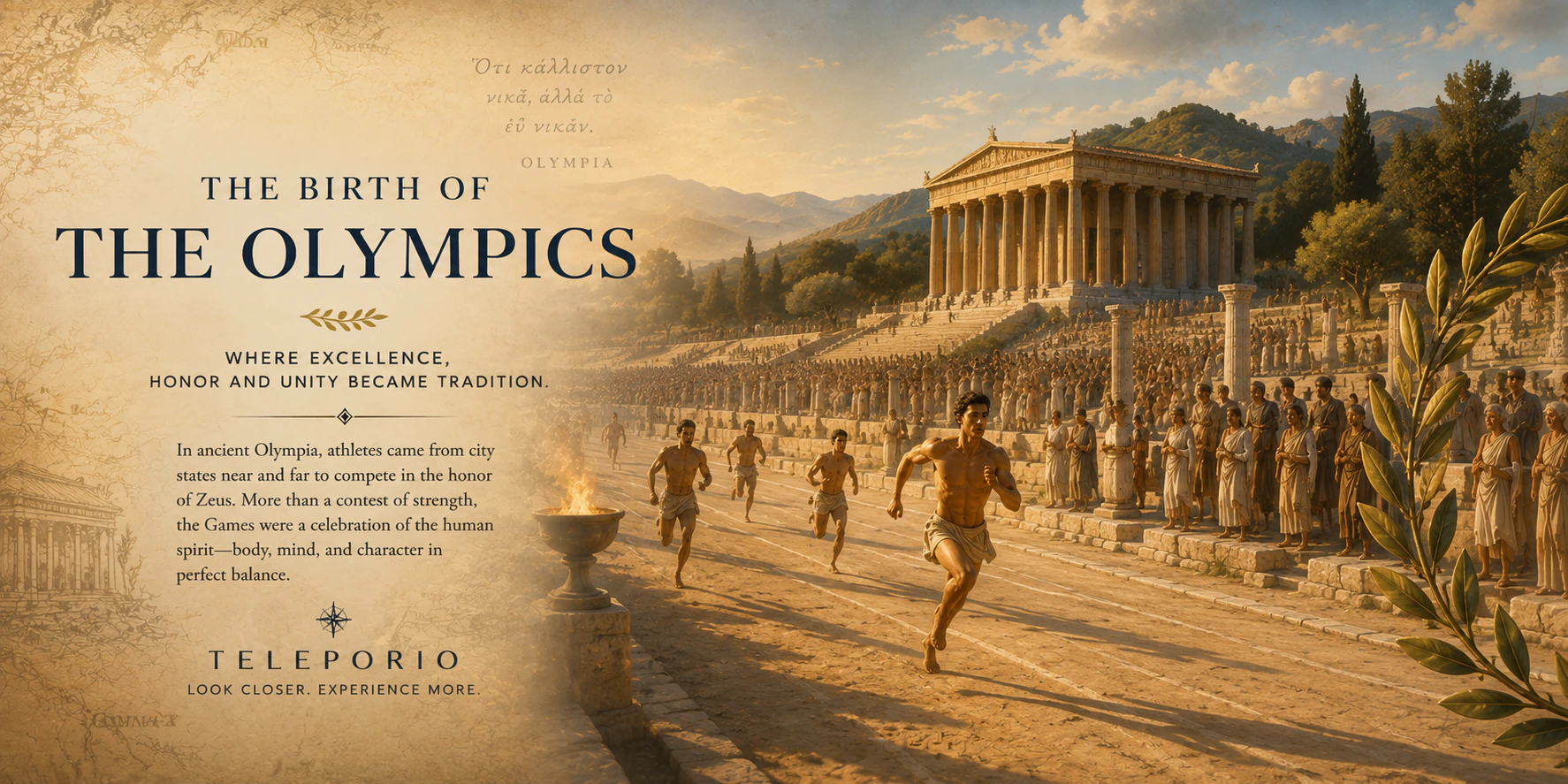
The ancient Olympics were not a sports competition that became religious. They were a religious ceremony that included athletic competition. That distinction shapes everything about what Olympia was.
Where Olympia is
Olympia is not a city. It is a sanctuary — a sacred place set in the valley of the Alpheios river in the northwestern Peloponnese, roughly 300 kilometres from Athens. Ancient Greeks travelled here from across the Greek world — from mainland cities, from islands, from colonies as far as Sicily and the Black Sea — because this valley was the home of the sanctuary of Zeus, the greatest of the Olympian gods, and because every four years a festival was held here that everything else was organised around.
A festival for Zeus
The ancient Olympic Games were, first and foremost, a religious event. The athletic competitions — foot races, wrestling, discus, javelin, chariot racing, the pentathlon — took place in honour of Zeus and were understood as offerings to him: the demonstration of human physical excellence before the god. The sanctuary of Olympia contained the great Temple of Zeus, which housed one of the Seven Wonders of the Ancient World: the chryselephantine (gold and ivory) statue of Zeus by the sculptor Pheidias. To compete at Olympia was not simply to win a race; it was to participate in a ceremony of dedicated excellence. Winners received an olive wreath — not gold or money — because the honour was considered its own reward.
The truce and the pan-Hellenic world
For the duration of the Olympic festival — traditionally, a period of several weeks — a truce was declared across the Greek world: the Ekecheiria, or Olympic Truce. Wars were suspended, travel was protected, and athletes and spectators could move safely across normally hostile territories to reach Olympia. The Games were pan-Hellenic: open to all free Greek men, regardless of which city-state they came from. In a world of perpetual fragmentation and warfare between Greek poleis, Olympia was one of the few places and occasions where the idea of a shared Greek identity was physically enacted. The modern values of the Olympic Games — competition among nations in peace, excellence over violence — carry the direct inheritance of this truce.
How long they ran
The traditional date for the first Olympiad is 776 BC. The Games continued, with remarkable continuity, for over a thousand years. They were suppressed in 393 AD by the Christian Emperor Theodosius I as part of a broader edict against pagan festivals. By that point, the Games had run for approximately 293 Olympiads — once every four years, for over a millennium. Very few human institutions have lasted as long.
The modern revival and why Athens was chosen
The revival of the Olympic Games in 1896 was primarily the achievement of a French baron, Pierre de Coubertin, who believed that competitive sport conducted in the spirit of the ancient Games could encourage international understanding. Athens was chosen for the first modern Games partly as a tribute to antiquity and partly because of strong Greek advocacy for the choice. The first modern Olympics were held in the reconstructed Panathenaic Stadium, built on the site of an ancient stadium, using Pentelic marble. The founding of the modern Games in Athens created the direct symbolic line between the ancient festival at Olympia and the international event we know today.
What is certain — and what is interpretation
The ancient Olympic Games are documented in ancient literary sources and confirmed by archaeology. The traditional founding date of 776 BC is ancient, though modern archaeology suggests athletic activity at Olympia before this. The modern revival in 1896 and its relationship to the ancient Games are matters of historical record.
Go See It
Archaeological site of Olympia, Peloponnese
Ancient Olympia is reachable by road or by train from Athens via Pyrgos (approximately 4–5 hours). The site is large and best explored across a morning. The archaeological museum at Olympia holds the sculptures from the Temple of Zeus — including the famous Nike of Paionios — and the Hermes of Praxiteles, if authentic, and is essential.
Sources and further reading
- International Olympic Committee — Ancient Olympic Games history — official
- Britannica — Olympic Games: ancient history — academic
- Greek Ministry of Culture — Archaeological site of Olympia — government
- UNESCO — Olympia World Heritage Site — international-organisation