Teleporio™ — Greek Island Travel Intelligence
Who was Pheidippides?
He ran from Athens to Sparta and back before the Battle of Marathon. The race that bears his legend is 42 kilometres. His actual run may have been over 480.
Teleporio™ travel intelligence — Updated 2026-07-24
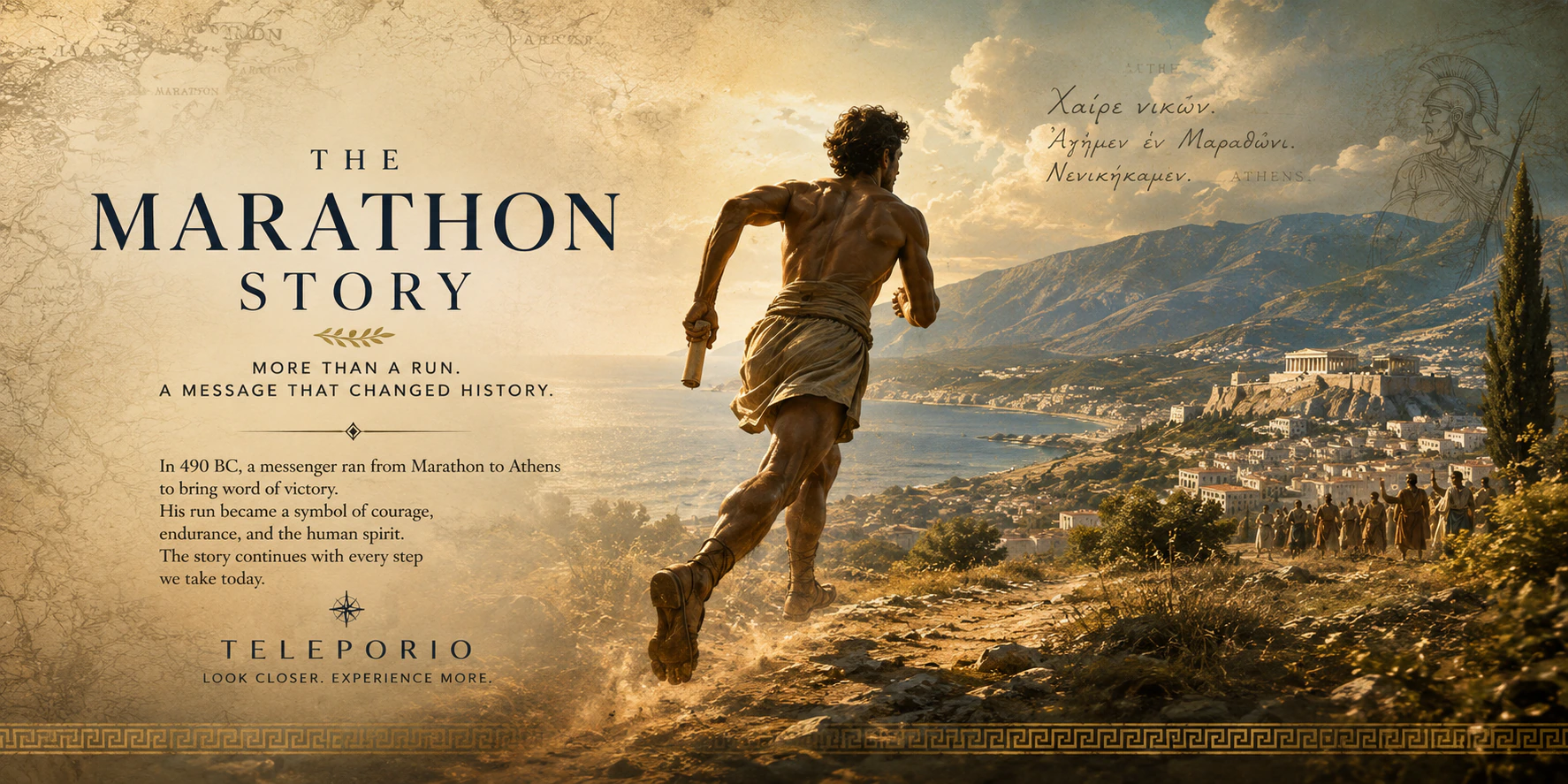
The marathon race is named after a place, not a person. Pheidippides is the name behind the person — but exactly which run he made, and whether the famous dying messenger story is him, is more complicated than the legend suggests.
What Herodotus actually says
The historian Herodotus, writing approximately a generation after the events of 490 BC, records that the Athenians, before the Battle of Marathon, sent a professional runner to Sparta to request military assistance. This man — named Pheidippides or Philippides (manuscripts vary) — ran from Athens to Sparta, a distance of roughly 240 kilometres across difficult terrain including mountain passes, in approximately two days. He delivered the message to the Spartan authorities, who were observing a religious festival and told him they would march after the full moon. He ran back to Athens. That account, from Herodotus, is the earliest documentation of the extraordinary runner.
The other run: from Marathon to Athens
The famous image — a soldier running the 40 kilometres from the plain of Marathon to Athens after the battle, announcing the Greek victory, and dying as he speaks — appears in ancient sources, but in the writing of Plutarch and Lucian, who wrote several centuries after the events. The runner is sometimes named Thersippus, sometimes Eucles, and sometimes identified with Pheidippides. Whether this was a distinct individual, a conflation with the Spartan run, or a later legendary accretion is debated by historians. The dying-messenger story is tradition and may contain historical memory, but it should be understood as tradition rather than unambiguous fact.
The Spartathlon
In 1982, a British RAF officer named John Foden researched the Herodotean account and proposed that the Athens-to-Sparta run was historically possible and could be recreated. The Spartathlon ultra-marathon — 246 kilometres from Athens to Sparta — has been run annually since 1983, and is regarded as one of the world's most demanding ultra-endurance races. It has given Pheidippides's documented run a modern life. Participants run through the same terrain, past the same mountains, within a fixed time limit. The race is a tribute not to the marathon-distance legend but to the longer, more verifiable account in Herodotus.
Why the distinction matters
The story of Pheidippides is a good example of how history and legend layer over each other in ancient sources — and why the layering matters. The verified story (the Spartan run, attested in Herodotus) is arguably more remarkable than the legendary one (the dying messenger), yet the legend is what gave the world the marathon. Both stories can be appreciated for what they are: one as documented history, one as the tradition that a race carried forward into modernity. Understanding the difference enriches both. It also changes what a visitor sees at Marathon: not a single neat route frozen in time, but a landscape where military history, later storytelling and the invention of a modern sporting tradition have been laid over one another.
What is certain — and what is interpretation
Herodotus records a runner named Pheidippides (or Philippides) who ran to Sparta before the battle. The story of the dying messenger running from Marathon to Athens with news of victory is attributed to later ancient sources (Plutarch, Lucian) and may conflate different events or individuals. The Spartathlon ultra-marathon, run since 1983, commemorates the Herodotean account.
Go See It
Marathon plain, Attica; the Panathenaic Stadium, Athens
The Marathon plain is accessible by bus from central Athens. The burial mound (Soros) of the Athenian dead is a moving and largely uncrowded site. The Panathenaic Stadium in Athens, where the modern marathon finishes, is open to visitors and provides the most emotionally resonant arrival point for understanding the 1896 connection.
Sources and further reading
- Herodotus, Histories, Book VI.105–106 — the primary ancient account — primary-ancient-source
- Spartathlon official site — the recreated Athens to Sparta run — official
- Britannica — Pheidippides — academic