Teleporio™ — Greek Island Travel Intelligence
Who was Maria Callas?
She was born in New York, raised in Athens during the occupation, and became the most celebrated operatic soprano of the twentieth century. Her voice changed…
Teleporio™ travel intelligence — Updated 2026-07-24
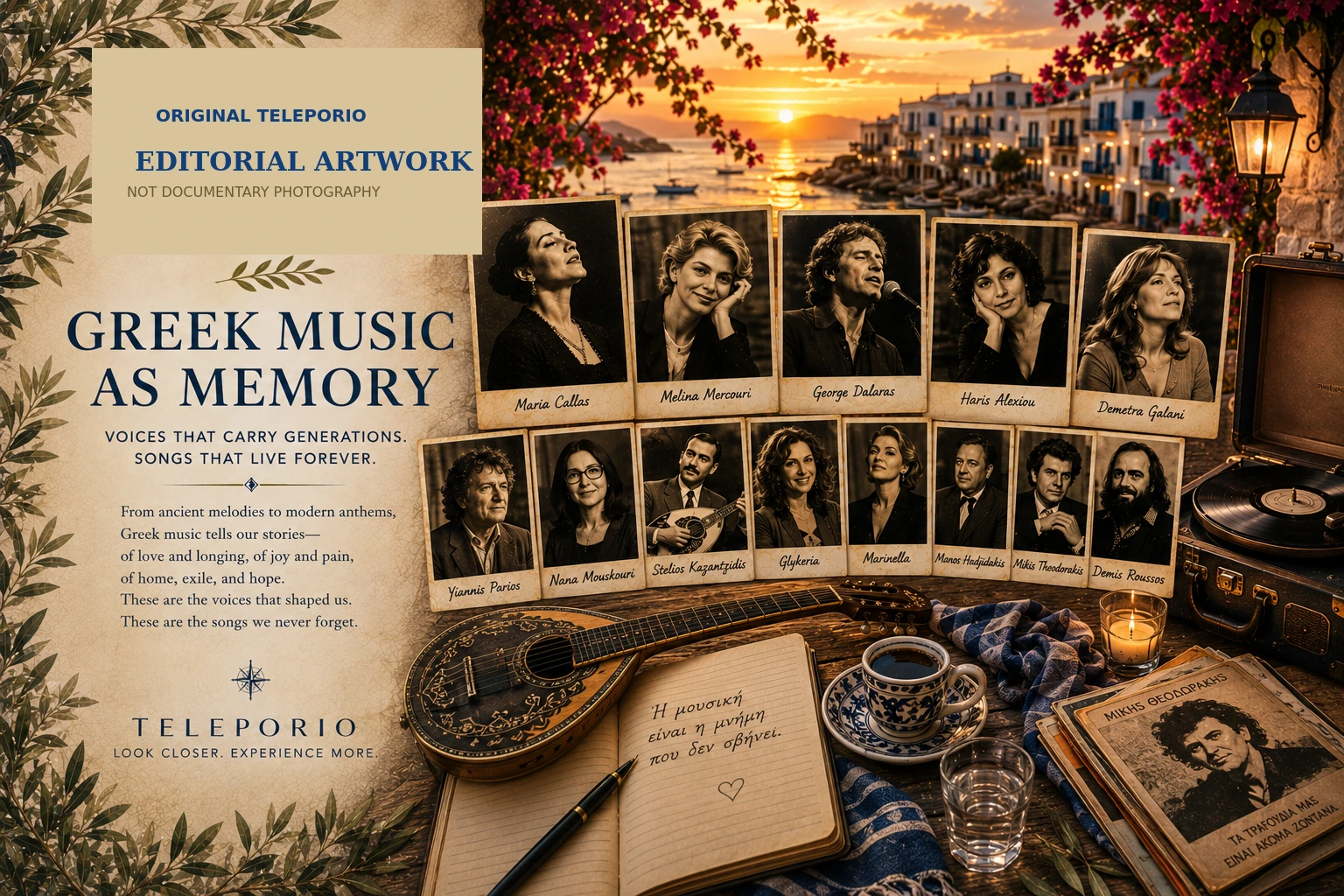
Maria Callas's full name at birth was Cecilia Sofia Anna Maria Kalogeropoulos. She was born in New York City in 1923 to Greek immigrant parents, and she returned to Greece as a child. Athens shaped her voice before the world heard it.
A Greek voice from New York
Maria Callas was born Cecilia Sofia Anna Maria Kalogeropoulos on 2 December 1923 in New York City, to Greek immigrant parents from central Greece. Her family returned to Greece — to Athens — when she was around thirteen years old, and it was there, at the Athens Conservatory (Odeion Athinon) and later at the Greek National Conservatory, that her voice was trained and her musical formation took place. Her primary teacher in Athens was the Spanish soprano Elvira de Hidalgo, whose influence Callas acknowledged throughout her career. Athens, not New York or Milan, is where her voice was made.
The voice and what it could do
What made Callas extraordinary was not simply the beauty of her tone — though the tone was remarkable — but the intelligence and expressiveness she brought to every phrase. Her voice was unusually wide in range, capable of great power in the dramatic passages and extraordinary delicacy in the soft ones, and she used it not as a technical instrument but as a means of inhabiting a character completely. She is associated above all with the bel canto repertoire — the Italian operas of Bellini, Donizetti and early Verdi — which she rescued from a period of relative neglect and showed could carry emotional depth as well as vocal brilliance. Conductors and directors who worked with her described an intensity of musical and dramatic preparation that was without parallel.
La Divina
The name by which Maria Callas came to be known — La Divina, the divine one — was an Italian press designation and captures the reverence she inspired, but it also risks flattening a human story. She was a figure of paradoxes: privately insecure, publicly dominant; extraordinarily disciplined and personally impulsive; beloved by audiences and sometimes at war with opera houses and colleagues. Her career at the highest level was intense and relatively short — roughly from the late 1940s to the mid-1960s — and its ending, associated with vocal difficulties and personal upheavals, was watched by the world. She retired largely from the stage by the early 1970s and died in Paris in 1977 at the age of fifty-three.
Athens and Greece in her life
Callas's relationship to Greece was complicated. Her formative years in Athens included the years of the Second World War and the German occupation of Greece, a period of extreme hardship for the country. She performed at the Athens Opera during the occupation years — a fact that she and others later reflected on with complexity. After the war, she pursued her career internationally and spent little time in Greece for long stretches. But the Greek press and public followed her career with great attention, and her identity as a Greek musician — however transnationally she lived — was never in question in either direction.
Why she matters to a traveller
To visit Athens knowing who Maria Callas was — knowing that the conservatories of this city shaped the voice that would redefine opera — gives the city a layer that the monuments alone cannot provide. The National Opera House (Ethniko Lyrico Theatro) is at the Stavros Niarchos Foundation Cultural Centre, on the southern coastal zone, and continues to present opera in the tradition she helped revive. Greece has a deep relationship with music across all its forms — classical, rebetiko, laïko, folk — and Callas stands at one end of that spectrum, the point where Greek musical formation met the widest international stage.
What is certain — and what is interpretation
Maria Callas's life and career are extensively documented. Biographical details draw from widely published and cross-checked sources. Her performances and their documented impact on opera are matters of critical and historical record. No quotes are attributed to her in this article.
Go See It
Greek National Opera at the Stavros Niarchos Foundation Cultural Centre, Kallithea, Athens
The Greek National Opera (Ethniko Lyrico Theatro) performs at the Stavros Niarchos Foundation Cultural Centre, a landmark building designed by Renzo Piano on the south Athenian coast. Performances are listed on the company's website and the season runs approximately October through June.