Teleporio™ — Greek Island Travel Intelligence
Who was Manos Hadjidakis — and how did he change the way Greece heard itself?
He defended rebetiko when polite society dismissed it, wrote an Oscar-winning song for Never on Sunday, and helped shape the modern Greek art-song tradition.
Teleporio™ travel intelligence — Updated 2026-07-24
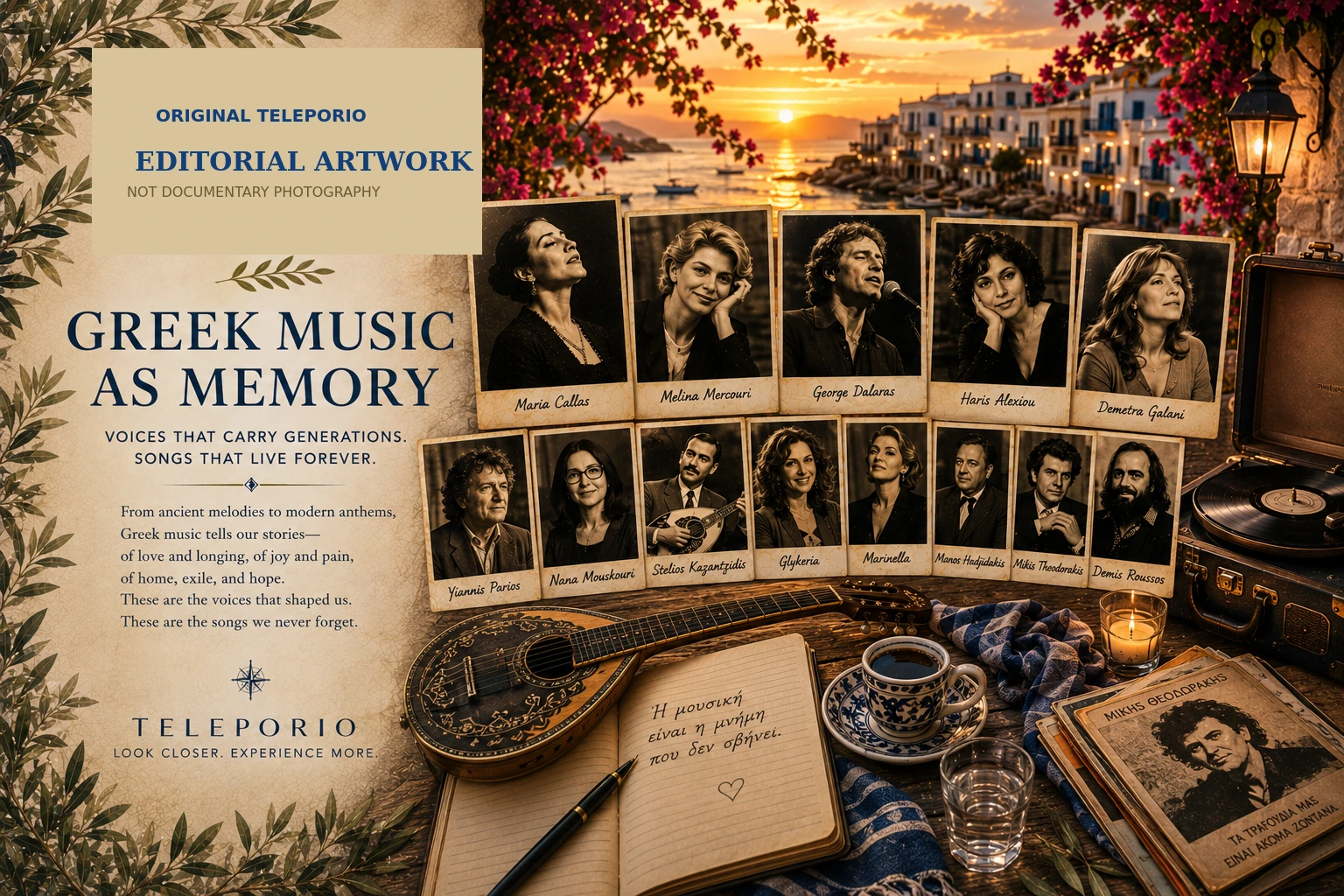
Manos Hadjidakis could move between a rebetiko melody, a poem, a film song and an orchestral work without accepting that one belonged to serious culture and another did not.
Xanthi, Athens and a self-made education
Manos Hadjidakis was born in Xanthi in 1925 and moved to Athens with his family as a child. During the occupation years he studied music and encountered poets and artists who would shape modern Greek culture. His education was never confined to one institution or genre. The city offered classical study, theatre, poetry, popular song and the music of neighbourhoods that respectable cultural life often preferred not to acknowledge.
The 1949 rebetiko lecture
In January 1949, Hadjidakis gave a public lecture at Karolos Koun's Art Theatre arguing for the artistic value of rebetiko. The intervention became famous because rebetiko was still associated with ports, prisons, hashish dens and socially marginal lives. Hadjidakis did not erase that history. He insisted that the music's melodic and emotional language deserved serious attention. The lecture helped change the terms on which educated Greek audiences could hear their own urban popular tradition.
Poetry, theatre and entechno
Alongside Mikis Theodorakis, Hadjidakis became central to the development of entechno, a broad field in which composed music, modern poetry and popular performance meet. He wrote for theatre, dance and cinema as well as concert settings. His long collaboration with poet Nikos Gatsos was especially important. The aim was not to make popular song respectable by disguising it as classical music, but to create work in which literary and vernacular forms could speak to one another.
The Children of Piraeus and the Oscar
Hadjidakis wrote the music for Jules Dassin's 1960 film Never on Sunday, starring Melina Mercouri. Its song The Children of Piraeus won the Academy Award for Best Original Song at the 1961 ceremony. The melody became an international shorthand for Greece, but it also came from a specific cinematic Piraeus of ports, tavernas and performance. Hadjidakis's later work ranged far beyond that success, and he resisted being reduced to the tune the world recognised most easily.
Institutions as part of composition
Hadjidakis also founded and directed musical institutions, including the Orchestra of Colours late in his life. This institution-building matters because his cultural argument required more than individual works. Audiences needed places where neglected compositions and adventurous programmes could be heard. For a traveller, his Athens is therefore not one monument. It is a network of theatres, cinemas, concert halls and neighbourhood music in which categories kept being challenged.
What is certain — and what is interpretation
Manos Hadjidakis (1925–1994) is a documented historical public figure. Biographical dates, the 1949 rebetiko lecture, institutional work and the Academy Award are supported by library, press and cultural records. A published article consulted during research contains quotations, but none are reproduced here.
Go See It
Piraeus, the Art Theatre and concert venues presenting Hadjidakis in Athens
Pair a walk through Piraeus with a performance or recording that goes beyond The Children of Piraeus. Check programmes at the Greek National Opera, Athens Concert Hall and summer festivals for Hadjidakis song cycles and orchestral work.