Teleporio™ — Greek Island Travel Intelligence
Who was Hippocrates — and why does his name still mean something?
He was a physician from Kos who, around the fifth century BC, insisted that illness had natural causes. That idea changed medicine.
Teleporio™ travel intelligence — Updated 2026-07-24
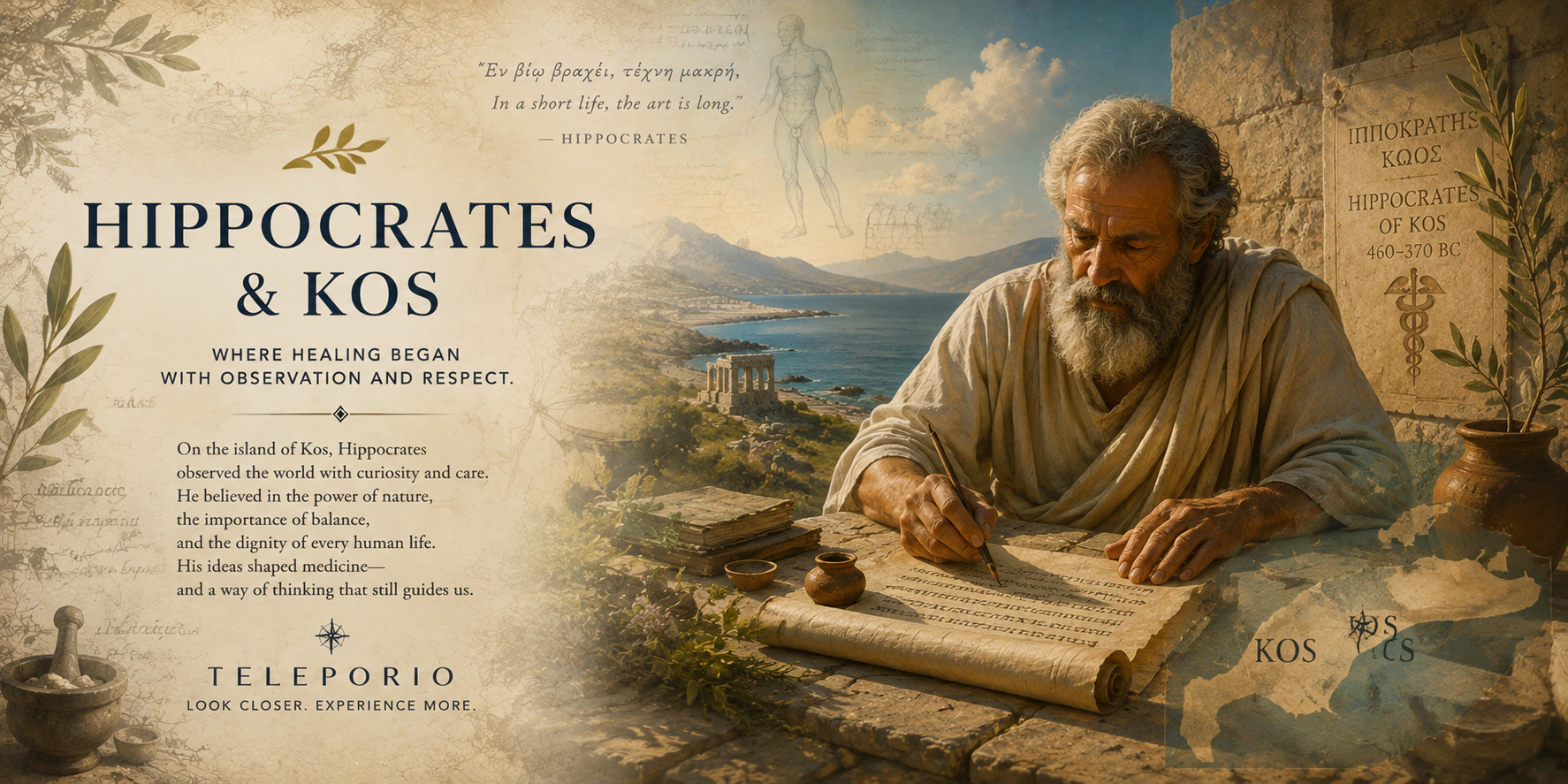
In Kos Town there is a large plane tree in a square near the harbour. Tradition calls it the Hippocrates Tree. It is not literally the tree under which Hippocrates taught — it is far younger than that — but the tradition is real, the location is historically significant, and the name is worth knowing before you sit in the shade.
The physician from the island
Hippocrates of Kos is traditionally dated to approximately 460–370 BC, making him a near contemporary of Socrates. He is associated with the island of Kos in the southeastern Aegean, where a long tradition of medical practice was established, connected with the cult of Asklepios, the god of medicine. Hippocrates is often called the 'Father of Medicine' in the Western tradition — a title that honours his historical importance while also compressing a more complicated story. He was not the first physician in the ancient world. What he, or the tradition that bears his name, represented was a decisive shift in how illness was understood.
The crucial idea: natural causes
Before the Hippocratic tradition, disease in the ancient world was widely understood in supernatural terms — as punishment from the gods, as the result of demonic influence, as a spiritual condition requiring ritual rather than physical treatment. The Hippocratic Corpus — the collection of texts associated with Hippocrates, though modern scholarship indicates they were likely written by multiple authors over several generations — consistently argued something different: that illness has natural causes, that it follows observable patterns, and that careful attention to the patient — their diet, their environment, their symptoms over time — produces better outcomes than prayer alone. This was not simply a medical insight; it was a philosophical one.
What the Hippocratic Corpus actually contains
The texts known as the Hippocratic Corpus include discussions of prognosis, epidemics, diet, surgery, fractures and fevers, as well as more philosophical reflections on the nature of medicine itself. The writing is observational: it records what happens to particular patients under particular conditions, what treatments were tried and what resulted. This emphasis on the patient's actual experience — rather than received doctrine — is what gives the Hippocratic tradition its claim to being a foundation of empirical medicine. The texts were not all written by the same hand, and attributing them uniformly to Hippocrates of Kos is a later tradition rather than a provable fact.
The Hippocratic Oath
The Hippocratic Oath — sworn by physicians to do no harm, to maintain confidentiality, and to practise medicine for the benefit of the patient — bears Hippocrates's name, though whether he composed it is not established. It likely dates from roughly the same period and tradition. Modern medical schools have adapted, replaced or rewritten the original oath in various ways, but the ethical principles it articulated — primacy of the patient's welfare, the duty not to harm, the importance of professional integrity — remain central to medical ethics across cultures. Hippocrates's name is attached to a set of values that medicine has never fully left behind.
Kos and the living tradition
The island of Kos holds two places connected to the Hippocratic tradition that are worth visiting. The Asklepion — a terraced healing sanctuary dedicated to Asklepios, located a few kilometres outside Kos Town — is one of the most important ancient medical sites in the world. Patients came here for healing through a combination of religious ritual, dream interpretation, physical treatment and rest; the site embodies the meeting of the sacred and the natural in ancient medicine. In Kos Town itself, the plane tree near the harbour is known by tradition as the Hippocrates Tree, though the current tree is estimated to be several hundred years old — far younger than Hippocrates's era. The tradition locates the memory of the physician here, even if the tree is not his tree. That distinction matters, and the tradition is real regardless.
What is certain — and what is interpretation
Hippocrates is a historical figure, though details of his life are poorly documented and sometimes conflated with later legendary tradition. The corpus of texts attributed to him (the Hippocratic Corpus) was likely produced by multiple authors over time. The Hippocratic Oath, while bearing his name, is not established as his direct composition. These distinctions are observed throughout this article.
Go See It
Asklepion of Kos and the Hippocrates Tree, Kos Town, island of Kos
The Asklepion is approximately 4 kilometres from Kos Town and accessible by bus, taxi or bicycle. The site is terraced into a hillside with views across the Kos Strait toward Turkey. Visit in the morning to avoid heat. The Hippocrates Tree in the plane tree square (Platia Platanou) near the harbour in Kos Town is a pleasant short walk from the main waterfront.