Teleporio™ — Greek Island Travel Intelligence
Who was Demis Roussos — and what made his music Mediterranean?
Born in Alexandria, remade in Athens and launched from Paris with Aphrodite's Child, Demis Roussos turned migration and a singular high tenor into internatio…
Teleporio™ travel intelligence — Updated 2026-07-24
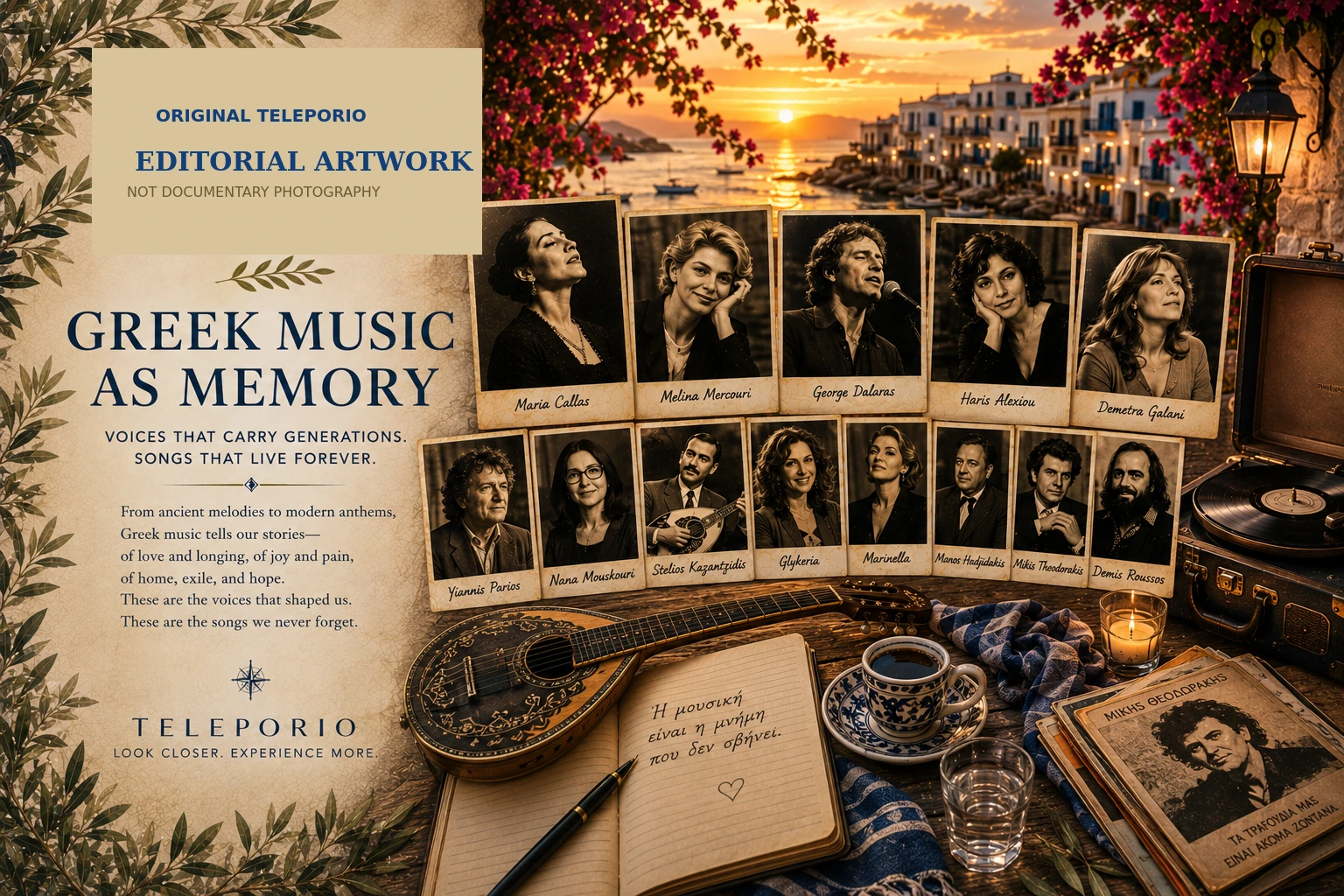
Demis Roussos is often remembered through the visual shorthand of kaftans and 1970s television. Listen past the image and another story appears: Alexandria, Greek diaspora, progressive rock, Paris and a voice built for crossing borders.
A Greek childhood in Alexandria
Artemios Ventouris-Roussos was born in Alexandria, Egypt, in 1946. His family belonged to the city's Greek community, and he sang in the choir of a Greek Orthodox church while also learning instruments. Alexandria's layered Greek, Egyptian, Italian and wider Mediterranean life formed the first setting of his musical identity. When political and social conditions changed, the family moved to Athens in 1961.
Athens, Vangelis and Aphrodite's Child
In Athens, Roussos played in bands and worked with keyboard player Evangelos Papathanassiou, later known internationally as Vangelis, and drummer Loukas Sideras. They formed Aphrodite's Child in 1967. Attempting to reach London, the group was redirected by travel problems and settled in Paris, where Rain and Tears became a continental European success. Roussos's unusually high tenor was central to the band's sound.
Progressive rock before the ballads
Aphrodite's Child was not merely a preface to a solo career. The group became an important part of European progressive rock, culminating in the ambitious album 666, based on imagery from the Book of Revelation. Its experimental reputation sits awkwardly beside the easy-listening label later attached to Roussos, which is precisely why the full story matters. His voice could inhabit dramatic rock arrangements before it became familiar through romantic pop.
The international solo years
After the group split, Roussos began a solo career that found large audiences across continental Europe and later Britain. Forever and Ever became his signature recording, and he often recorded songs in several languages. Television amplified both the voice and the distinctive stage image. The music was cosmopolitan popular entertainment, but its melodic sweep and vocal ornament still suggested an eastern Mediterranean background to listeners who might never have known the geography.
A different route through Greek music
Roussos does not fit the familiar line from rebetiko through laïko and entechno. His route runs through diaspora Alexandria, Athens pop groups, Paris studios, progressive rock and multilingual European television. That difference makes him essential to the artwork's account of Greek music as memory. Greek identity has never been contained only inside the modern state's borders. It has also been shaped by communities that moved, adapted and made recognisably Mediterranean work in international forms.
What is certain — and what is interpretation
Demis Roussos (1946–2015) is a documented historical public figure. Dates, migration, band history and chart career are drawn from BBC and Guardian reporting and music reference sources. Contemporary descriptions of his voice are paraphrased rather than quoted. No unsupported sales claim or invented interview is included.
Go See It
Athens music neighbourhoods and record collections tracing 1960s Greek rock
Look beyond greatest-hits compilations: listen first to Aphrodite's Child, including 666, and then to the early solo recordings. In Athens, independent record shops and music archives offer a better route into this period than a single commemorative site.
Sources and further reading
- BBC — Demis Roussos: A colourful career — news-archive
- The Guardian — Demis Roussos obituary — news-archive
- AllMusic — Demis Roussos biography and discography — music-reference