Teleporio™ — Greek Island Travel Intelligence
Where did the marathon come from?
A battle, a messenger, a legend, and a race invented for the first modern Olympics. The marathon is one of sport's most layered stories — and not everything …
Teleporio™ travel intelligence — Updated 2026-07-24
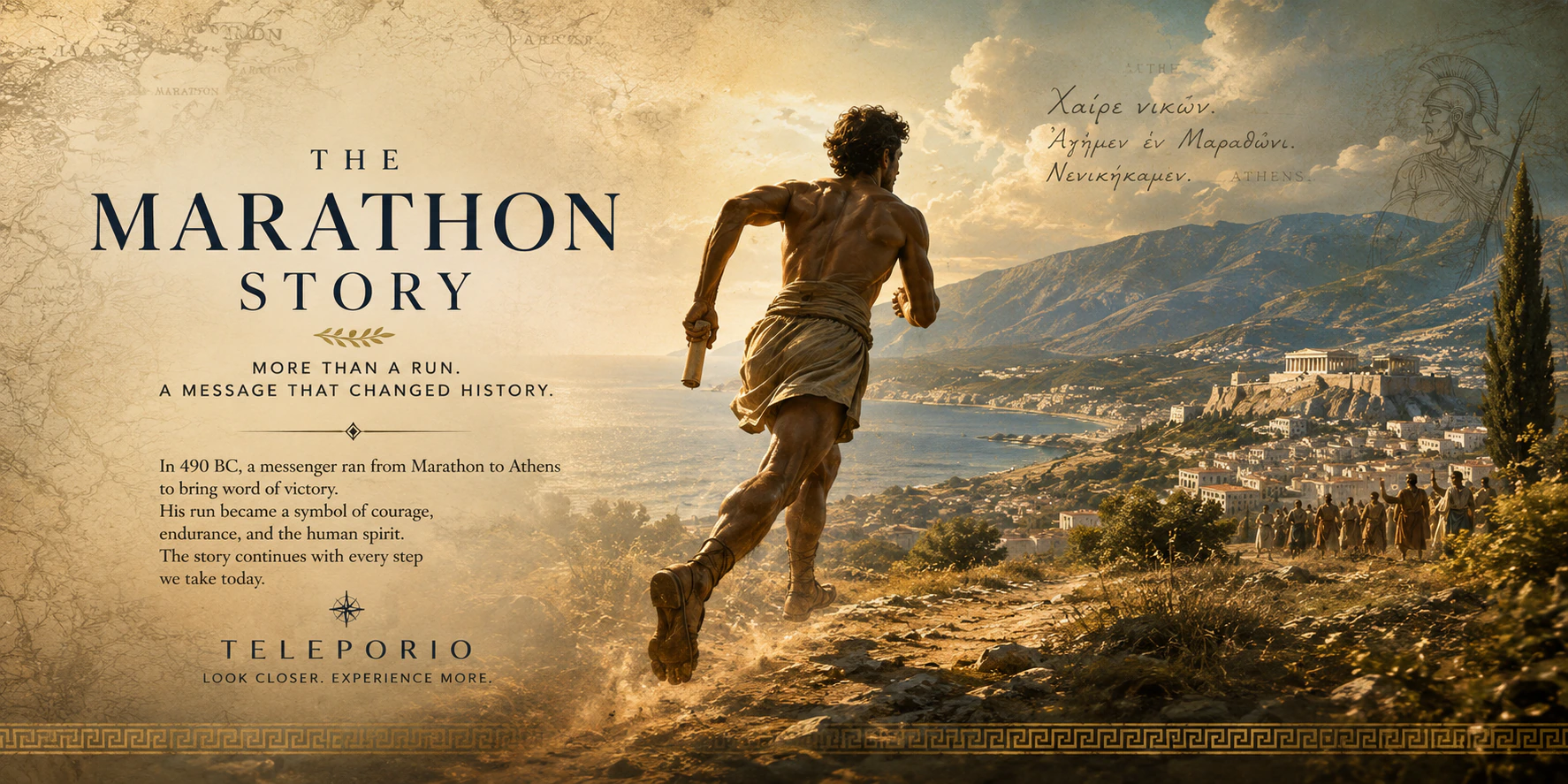
The word 'marathon' is a place name first. The village, the coastal plain and the bay of Marathon are roughly 40 kilometres northeast of Athens — and the story begins there, not with a race.
The battle that changed history
In 490 BC, a Persian army landed on the coastal plain of Marathon in Attica — approximately 40 kilometres northeast of Athens. The Persian force was part of the first major Persian invasion of mainland Greece, and the Athenian army that met them was significantly outnumbered. The battle that followed was a decisive Greek victory: the Athenians (aided by soldiers from Plataea) routed the Persians and drove them back to their ships. The significance cannot be overstated: a small Greek city-state had defeated the largest empire in the known world. It was, for Athens, the defining moment of its rising power.
Pheidippides: the messenger and the history
The ancient sources tell of a long-distance runner associated with the Marathon campaign, though the story is more complicated than the popular version. The historian Herodotus, writing roughly a generation after the battle, records that before the battle a professional runner named Pheidippides (or Philippides in some manuscripts) was sent from Athens to Sparta — approximately 240 kilometres each way — to request Spartan military assistance. That extraordinary run of two days is documented. A different tradition, recorded later by writers including Plutarch and Lucian, describes a soldier running from Marathon to Athens after the battle to announce the victory, saying 'We have won' (or 'Rejoice, we conquer' in the Latinised version) before dying. Whether this second figure is also Pheidippides, or a different person, or a legendary conflation, is not established. The dramatic dying messenger is part of the tradition but not unambiguous history.
The race invented for the 1896 Olympics
The modern marathon race was created specifically for the 1896 Athens Olympics — the first Games of the modern era — at the proposal of French philologist Michel Bréal, who was inspired by the ancient tradition and wanted to include an event connecting the ancient world to the modern Olympics. The route he proposed ran from the village of Marathon to the Panathenaic Stadium in Athens, covering approximately 40 kilometres. Bréal even offered a silver cup to the winner of the first race. The event was held on 10 April 1896. Twelve athletes started from Marathon and headed toward Athens.
Who was Spyros Louis?
The 1896 marathon was won by a Greek water carrier from a village north of Athens named Spyros Louis, who completed the course in approximately 2 hours 58 minutes. His victory was received with extraordinary emotion in the stadium: a Greek man, in the birthplace of the ancient Games, winning the race that most directly connected the modern Olympics to ancient history. Louis ran the course, delivered the news of his approach to King George I, and entered the stadium to a crowd in ecstasy. He did not race competitively again, returned to his village, and reportedly lived a quiet life. His victory became one of the founding mythologies of modern Olympic sport. He was awarded various honours in later life, including by the IOC.
The marathon today
The modern marathon distance was standardised at 26 miles 385 yards (42.195 kilometres) in 1921, following adjustments at various early-twentieth-century Olympics. The Athens Classic Marathon, run each November, still follows the original 1896 route from Marathon to the Panathenaic Stadium — and finishing in the marble stadium that hosted the first modern Games is one of the most historically resonant moments in recreational sport. The Panathenaic Stadium itself, built in ancient times and reconstructed in Pentelic marble for 1896, is the only stadium in the world built entirely of marble and is still in use.
What is certain — and what is interpretation
The Battle of Marathon (490 BC) is well-documented by Herodotus and other ancient sources. The story of a messenger run is attested in ancient sources, though the precise route and the famous dying declaration belong to later tradition. The modern marathon race was created in 1896 for the Athens Olympics. These layers are clearly distinguished throughout.
Go See It
Panathenaic Stadium (Kallimarmaro), Athens; and the Marathon plain and tomb, Attica
The Panathenaic Stadium is easily walkable from central Athens, near the National Garden. It is open to visitors and you can run on the track. The Marathon plain is accessible by bus from Athens (Marathonas line from Pedion tou Areos bus terminal). The burial mound of the Athenian fallen (the Soros of Marathon) is a significant site beside the main road.