Teleporio™ — Greek Island Travel Intelligence
What were the ancient Olympic Games really like?
Thousands of spectators, olive wreaths for winners, no women allowed in competition, and a sacred truce across the Greek world. The ancient Games were unlike…
Teleporio™ travel intelligence — Updated 2026-07-24
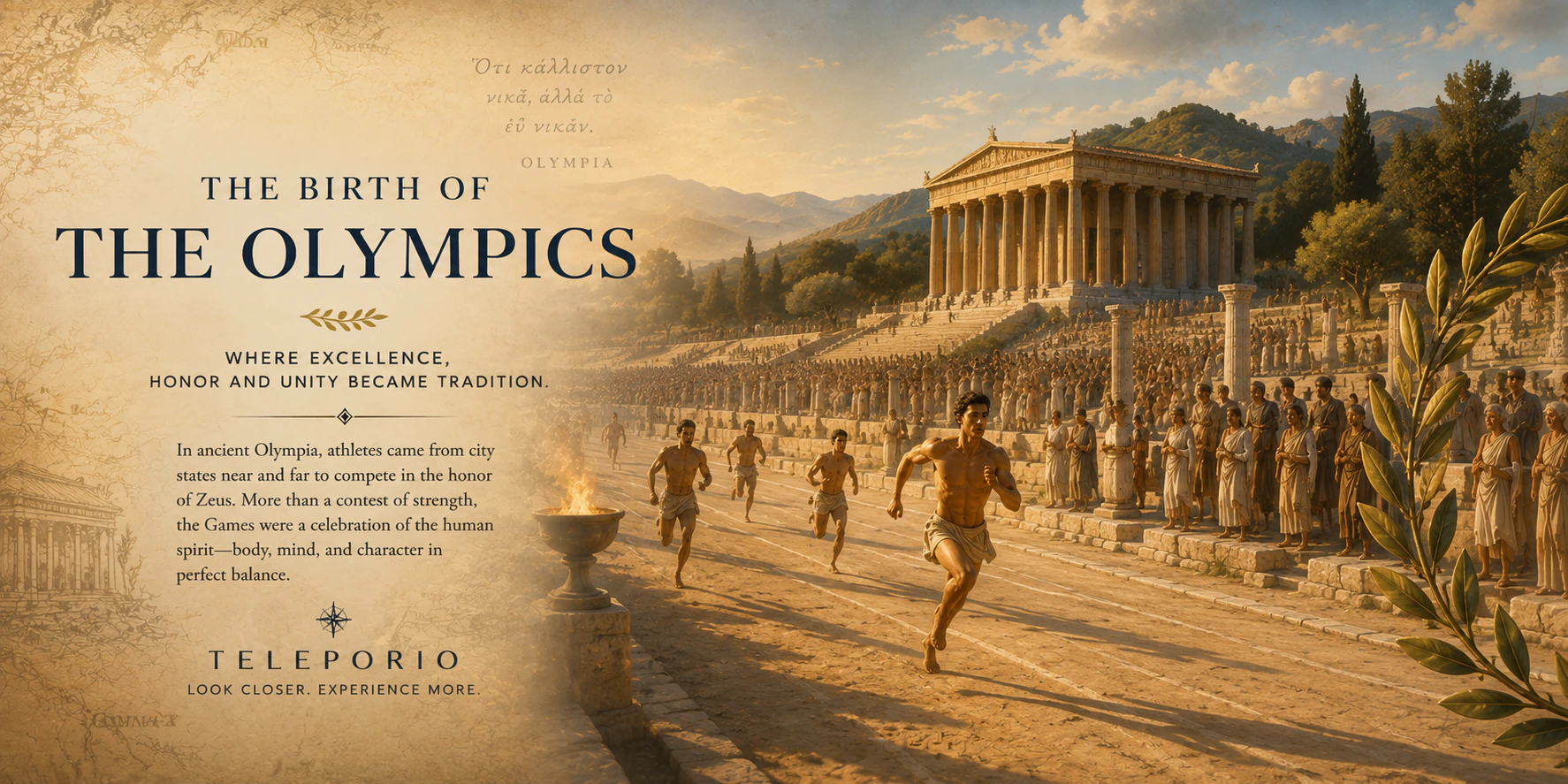
The ancient Olympic stadium at Olympia is still there — a grassed track with the original stone starting blocks at one end. You can stand at the start and look down the length of the stade. It is one of the most affecting places in all of Greece.
What the Games included
At their fullest development, the ancient Olympic Games included a range of events spread across several days: foot races of varying lengths (the stade, approximately 192 metres; the diaulos, double-length; the dolichos, a long-distance race of varying lengths), wrestling, boxing, the pancration (a largely unrestricted combat sport combining elements of both), the pentathlon (discus, javelin, long jump, foot race and wrestling), horse racing, and chariot racing. The chariot race was particularly prestigious because it required wealth — a sponsor entered and owned the horses and chariot, while a hired driver might do the actual racing. The sponsor still received the victory wreath.
The winner's reward
Olympic victors received a wreath of wild olive leaves cut from the sacred olive tree beside the Temple of Zeus — not money, not gold, not a medal. The honour was considered its own reward, and the prestige was enormous. A victor returned home to a city that might knock a hole in its own wall for him, because a city whose citizen had won at Olympia was considered not to need its walls for defence — the gods would protect it. Poets such as Pindar were commissioned to write victory odes celebrating winners, and some of those odes survive, giving us vivid portraits of what the victory meant to athletes and their cities.
Who could compete
The ancient Games were open to free Greek men. Non-Greeks (barbarians, in the ancient Greek sense of those who did not speak Greek) were excluded from competition, as were slaves. Women could not compete and, in the classical period, were not permitted to watch — with the exception of the priestess of Demeter, who had an official seat of honour. There was a separate festival for women, the Heraia, also held at Olympia, though it was a distinct event with a different history and character.
The sacred fire and the sacrifice
The ancient Olympics were inseparable from religious ceremony. The festival opened with a procession, prayers and sacrifice to Zeus. The great altar of Zeus — not a carved structure but a rising mound of ash accumulated from centuries of sacrifices — was a central feature of the sanctuary. The lighting of sacrificial fires was essential to the festival's meaning. The modern Olympic flame ceremony at Olympia, in which actresses dressed as ancient priestesses use a parabolic mirror to ignite a flame from the sun, is a twentieth-century creation; but it draws symbolic meaning from the genuine ancient connection between Olympia and sacred fire.
Where to experience it
The most affecting place to feel the ancient Games is the stadium itself — the ancient running track at Olympia, open to visitors, with original stone starting blocks preserved at one end. Walking onto the track and looking down its length is one of the simplest and most powerful experiences available in Greece. The museum at Olympia displays the armour, sculptures and objects that fill in the human detail: a helmet dedicated to Zeus, athlete's equipment, the sculptures from the Temple of Zeus. Together, site and museum tell the story that the modern Games carries as its inheritance.
What is certain — and what is interpretation
Details of the ancient Games draw from ancient literary sources (Pindar, Pausanias, Herodotus, Thucydides) and from archaeological evidence at Olympia. Specific customs and regulations are attested in ancient sources and noted as such.
Go See It
Ancient Olympic stadium and Archaeological Museum of Olympia, Peloponnese
Allow at least half a day for the site and museum together. The stadium is at the far end of the sanctuary from the entrance — keep walking. The original starting block at the west end of the track is preserved in place. The Archaeological Museum is one of the finest in Greece and is essential viewing.