Teleporio™ — Greek Island Travel Intelligence
What is a Greek panigyri?
A feast day, an all-night celebration, music and dancing in the village square. The panigyri is how a community celebrates the saint it belongs to — and how …
Teleporio™ travel intelligence — Updated 2026-07-24
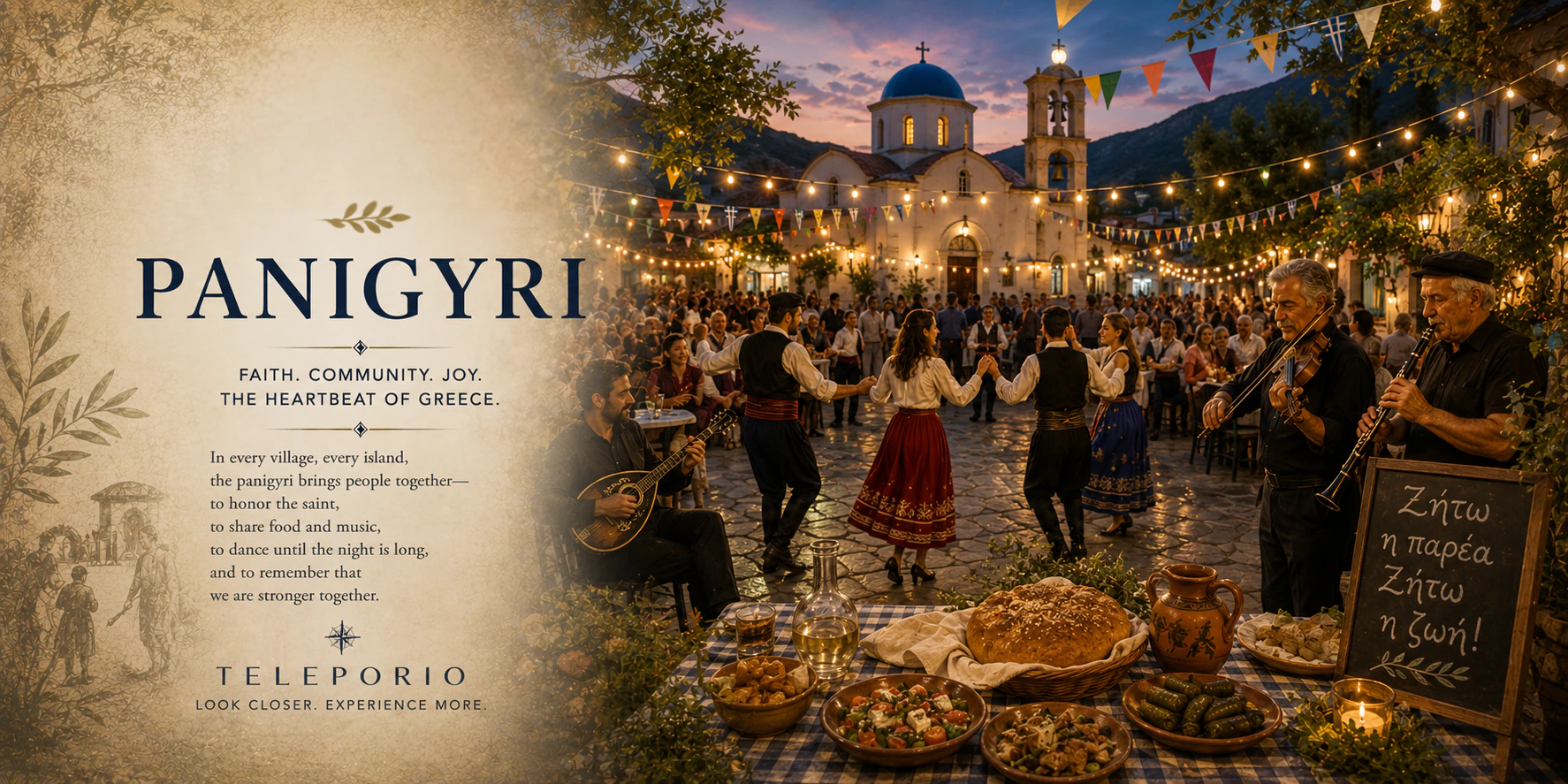
If you are lucky enough to be in a Greek village or island on the feast day of the local saint, you will find the square transformed by evening. This is not a tourist event. It is real community life — and you are welcome to join it.
What panigyri means
The word panigyri (πανηγύρι) comes from the Greek for 'a gathering of all' — pan (all) plus agora (gathering, assembly). In practice it is the festival held on the feast day of a church's patron saint: a combination of religious observance and community celebration that typically begins with an evening liturgy and continues through the night with music, dancing, food and drink. The panigyri is one of the most persistent and living elements of traditional Greek community life, and it continues in villages and islands across Greece in forms that, while inevitably varied, carry a recognisable character.
The structure of the feast
A typical panigyri follows a recognisable sequence. The day begins with a liturgy in the church, sometimes preceded by vespers the evening before. After the liturgy, the community moves to the village square or the plateia — the central gathering place — and the celebration begins. Tables are set out. Food is prepared and shared — often grilled meat, bread, olives, local wine or tsipouro. Musicians arrive — typically playing traditional instruments such as the lyra (in Crete and the Dodecanese), the laouto (a long-necked lute), the clarinet and the violin in different regions — and the dancing begins. The dances are traditional, circular, community dances in which anyone can join, and they continue through the night.
Who is there
One of the most striking aspects of a panigyri, for a visitor from a culture in which community events tend to be age-stratified, is the breadth of participation. Grandparents and small children, teenagers and middle-aged couples, the priest and the local fishermen — everyone is at the same celebration, on the same square, eating the same food, dancing the same dances. The panigyri is, among its many functions, a mechanism of social cohesion: it enforces the continuity of tradition across generations by making participation the natural thing, the thing everyone does.
The seasonal dimension
Many of the most celebrated panigyriat in Greece take place in summer, when the island and village communities are at their fullest and the long warm nights make outdoor celebration natural. The feast of the Assumption of the Virgin Mary (15 August) is the largest single panigyri occasion in Greece, celebrated with special intensity at Tinos and Paros but observed across virtually the entire country. Other major celebrations include the feast of Agios Nikolaos (6 December), the feast of Agios Georgios (23 April), and dozens of island and village patron saints whose feast days are particular to their community.
Why a traveller should seek one out
The panigyri is, more than almost anything else a traveller can attend in Greece, an occasion when the culture is unperformed. It is not for visitors; it is for the community. But it is open, and it is welcoming, and if you arrive with respect and curiosity — sit down, accept a glass of wine, watch the dancing before you join it — you will find yourself inside something that no museum and no restaurant can replicate. You will be inside Greek village life as it has been lived, in broadly recognisable form, for many centuries. That is worth going out of your way for.
What is certain — and what is interpretation
The panigyri tradition is described here from widely published ethnographic, cultural and travel sources, as well as Greek Orthodox official sources on feast days. Regional and individual variation in panigyria is significant; this article describes general patterns without over-generalising.
Go See It
Any Greek village or island on the feast day of its patron saint — try Rhodes, Crete, Sifnos, Ikaria (famous for its panigyriat) or local villages near any destination
Ikaria island in the northeastern Aegean is particularly famous for its panigyriat, which are noted for their warmth and hospitality toward visitors. The island of Sifnos also has strong festival traditions. Ask locally wherever you are — a panigyri is usually announced in the village or at the local church.